
The Albert Memorial
A Gilded Love Letter in the Heart of London
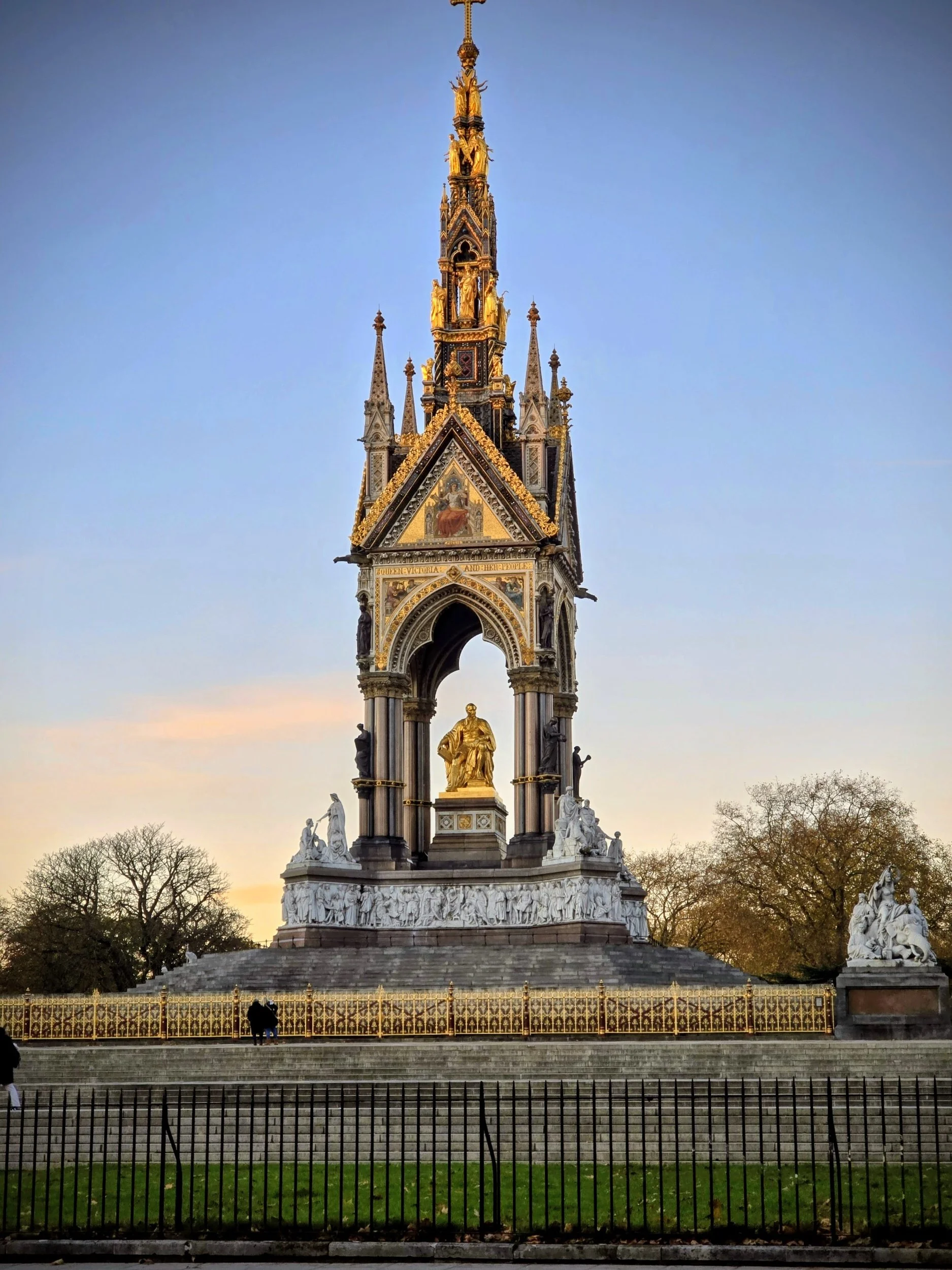
In the quiet, emerald expanse of Kensington Gardens, directly opposite the crimson-brick majesty of the Royal Albert Hall, stands perhaps the most extravagant monument ever conceived for a single man. The Albert Memorial is not merely a statue; it is a 176-foot-tall "Gothic Extravaganza"—a gilded, marble-encrusted shrine to a husband whose death froze the Victorian era in a state of perpetual mourning.
For the readers of Explorers Insight, we dive deep into the symbolism, the architectural drama, and the secrets of the monument that defined a Queen and her Empire.
The Grief that Built a Landmark
When Prince Albert died of typhoid fever in 1861 at the age of 42, Queen Victoria was shattered. She retreated into a black-clad widowhood that would last 40 years. To honor the man she called "her soul," she commissioned a national memorial that would represent his passions: art, science, and the progress of the British Empire.
Designed by the preeminent Gothic Revivalist Sir George Gilbert Scott (the genius behind St. Pancras Station), construction began in 1864. It took nearly a decade to finish the structure, and even longer for the central statue to be gilded and placed. The total cost was £120,000—equivalent to over £15 million in 2026—funded by a mix of Parliamentary grants and public donations from a grieving nation.
Architect of the Gothic: George Gilbert Scott’s Vision
Scott’s design was a "ciborium"—a type of ornate canopy usually found over a high altar in a cathedral. He drew inspiration from the Eleanor Crosses (medieval monuments built by Edward I for his wife) and the Scaliger Tombs in Verona.
The result is a pinnacle of Victorian Gothic architecture, featuring pointed arches, intricate stone tracery, and a spire that reaches toward the heavens, topped by a golden cross. Every inch of the structure is a narrative, intended to be "read" like a book of Victorian values.
Decoding the Memorial: A World in Miniature
The Albert Memorial is a hierarchy of sculptures. As you walk around it, the monument tells the story of the 19th-century world through four distinct layers.
The Four Continents (The Outer Plinths)
At the furthest corners of the railings stand four massive marble groups representing the "four quarters of the globe" as the Victorians saw them:
Europe: A bull (representing the myth of Europa) surrounded by figures representing Britain, France, Germany, and Italy.
Asia: An elephant carrying a figure of Asia, flanked by an Indian woman, a Chinese potter, and an Arab merchant.
Africa: A camel being led through the desert, featuring Egyptian and North African figures.
America: A charging bison with figures representing the United States, Canada, and Mexico.
The Industrial Arts (The Inner Corners)
Closer to the canopy, four groups represent the "useful arts" that Albert championed during the Great Exhibition of 1851: Agriculture, Manufacture, Commerce, and Engineering.
Insight: In the "Engineering" group, look for the steam cylinder and the gear—symbols of the cutting-edge technology Albert believed would change the world.
The Frieze of Parnassus
At the base of the central canopy is the most remarkable feature: a continuous relief of 169 life-size figures. This is the Frieze of Parnassus. It depicts the world’s greatest artists, poets, musicians, sculptors, and architects from history.
South Side: Musicians and Poets (Chaucer, Shakespeare, Handel).
East Side: Painters (Raphael, Michelangelo).
North Side: Architects (Wren, Scott himself).
West Side: Sculptors.
The Virtues and Angels
As your gaze moves up the spire, you’ll see gilded bronze statues of the Moral and Christian Virtues (Faith, Hope, Charity, Humility, Fortitude, Prudence, Justice, and Temperance). Above them, eight angels stand in various poses of mourning and exaltation.
Prince Albert: The Seated Gilded King
At the heart of the canopy sits the man himself. Prince Albert is portrayed in his robes as a Knight of the Garter. He isn't holding a sword or a scepter; instead, he holds the catalogue of the Great Exhibition of 1851. This was his greatest achievement—a world’s fair that brought nations together in the name of industry and peace.
The "Black" Statue Mystery: For most of the 20th century, the statue of Albert was black. Many believed Victoria had ordered it painted black in mourning, or that pollution had stained it. In reality, it was blackened during World War I to prevent the shiny gold from acting as a target for German Zeppelin raids. It remained dark until the massive 1990s restoration.
The Great Restoration of 1998
By the 1980s, the memorial was literally falling apart. In 1983, a heavy lead cornice fell from the canopy, prompting a total closure. It took years of meticulous work to restore the mosaics, clean the marble, and re-gild the statue with 24-carat gold leaf. When Queen Elizabeth II unveiled the restored monument in October 1998, it was the first time in 80 years that Londoners saw Albert "shine" as Victoria intended.
-
Is it free to visit?
Yes, you can view the memorial for free from behind the ornate railings at any time Kensington Gardens is open (5:00 AM – Dusk).
Can I go inside the railings?
Insight: Normally, no. However, The Royal Parks offer exclusive "Inside the Railings" tours (usually on the first Sunday of the month from March to December). These 50-minute tours allow you to see the Frieze of Parnassus up close.
What is the nearest Tube station?
South Kensington (Piccadilly, District, Circle) or Knightsbridge (Piccadilly). It is about a 10–15 minute walk from either
-
What is the best photo spot?
For the iconic shot, stand on the steps of the Royal Albert Hall across the street. This allows you to capture the scale of the monument against the sky.
When is the best light?
Go at Golden Hour (the hour before sunset). The low sun hits the 24-carat gold leaf, making the entire structure glow with an almost supernatural light.
-
After visiting the memorial, walk exactly 100 meters east to see the Coalbrookdale Gates. These massive bronze-painted iron gates were actually made for the Great Exhibition of 1851 and moved here later. They are a perfect companion piece to the memorial's industrial themes.