
Mathematical Bridge
The Enlightenment Geometry of Silver Street
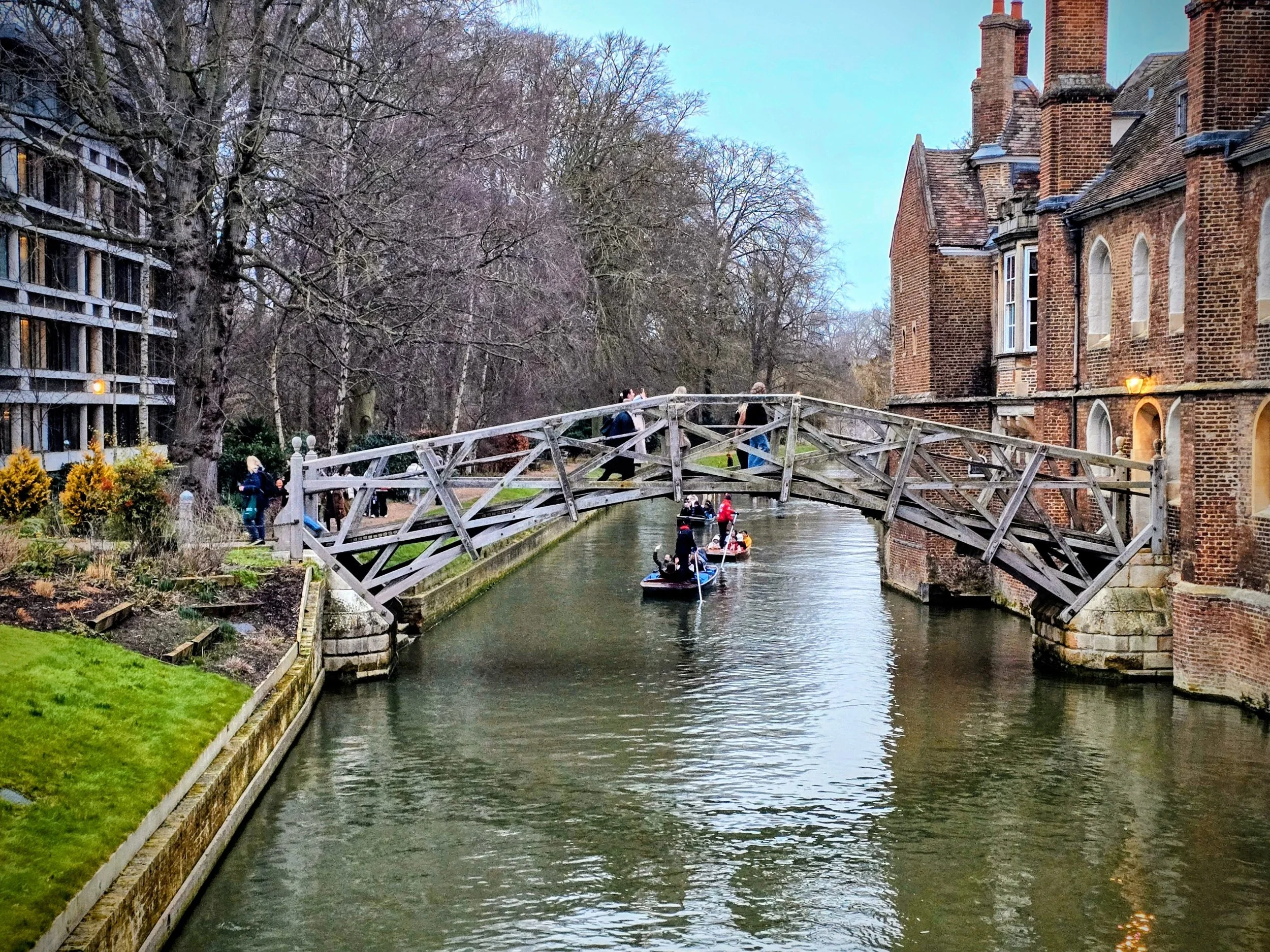
The Intersection of 18th-Century Engineering and Academic Myth
Standing over the water and connecting the medieval and modern halves of Queens’ College, the Mathematical Bridge Silver Street Cambridge is perhaps the most misunderstood structure in East Anglia. To the casual tourist passing by, it appears as a quaint wooden arch; to the Explorers Insight reader, it is a masterclass in 18th-century structural joinery and a prime example of how architectural myths can often overshadow historical reality.
In the Cambridge of 2026, where digital recreations of historical sites are common, the physical presence of this bridge serves as a vital reminder of the analog genius of the Enlightenment.
The Newton Myth vs. The 1749 Reality
One of the most persistent legends in the city is that Sir Isaac Newton designed and built the bridge without a single nut or bolt. According to the myth, inquisitive students later dismantled it to see how it worked and, unable to solve the "mathematical puzzle," were forced to reassemble it using the iron bolts visible today.
While it makes for a compelling story, the chronology is impossible. Newton died in 1727, twenty-two years before the bridge was actually constructed in 1749. The structure was actually designed by William Etheridge and built by James Essex the Younger. The iron bolts were always part of the design—the true "mathematical" insight wasn't the absence of fasteners, but the sophisticated geometry of the timber itself.
Engineering the Arch: Tangents, Radials, and Straight Timbers
The structure earns its name from the specific arrangement of its timbers. Unlike a traditional arched bridge that uses curved wood, Etheridge utilized a technique known as radial stepping.
By using entirely straight timbers arranged as tangents to the arch, interconnected by radial members, he created a self-supporting structure of immense strength. This design allows compressive forces to be distributed evenly across the frame. It is a physical manifestation of the coordinate geometry being taught in the nearby colleges at the time—a bridge that is, quite literally, a calculated proof in wood.
Strategic Insights: Navigating the Mathematical Bridge Silver Street Cambridge
The true historical context of the bridge is best understood by observing its role as a "threshold" between two distinct eras of Queens’ College. On the east bank sits the "Dark Side," home to the medieval Old Court and the Cloister Court, while the west bank—accessible via the bridge—is the "Light Side," featuring the more modern residential buildings. To capture the most analytical view of the timber joinery, one should position themselves on the public Silver Street Bridge at midday; the high sun highlights the interplay of the radial members against the dark water below. Furthermore, those seeking a deeper dive into Etheridge's work can find the original 1748 model of the bridge preserved in the Queens' College Library, offering a rare look at the prototype that preceded the full-scale landmark.
-
No. While the design remains faithful to Etheridge's original drawings, the bridge has been rebuilt twice—once in 1866 and again in 1905. The 1905 reconstruction replaced the original oak with teak, which is more resistant to the damp conditions of the Fens.
-
Access to the bridge is restricted to members of Queens’ College and visitors who have paid for entry to the college grounds. However, the best architectural views are actually from the public pavement on Silver Street or from a punt on the river below.
-
This is a common confusion with the "Grasshopper Escapement" found in clocks. While both involve sophisticated geometry and are associated with Cambridge, the bridge’s name has always leaned into its mathematical complexity rather than a specific insectoid movement.