
Newton’s Apple Tree
A Living Archive of Universal Gravitation
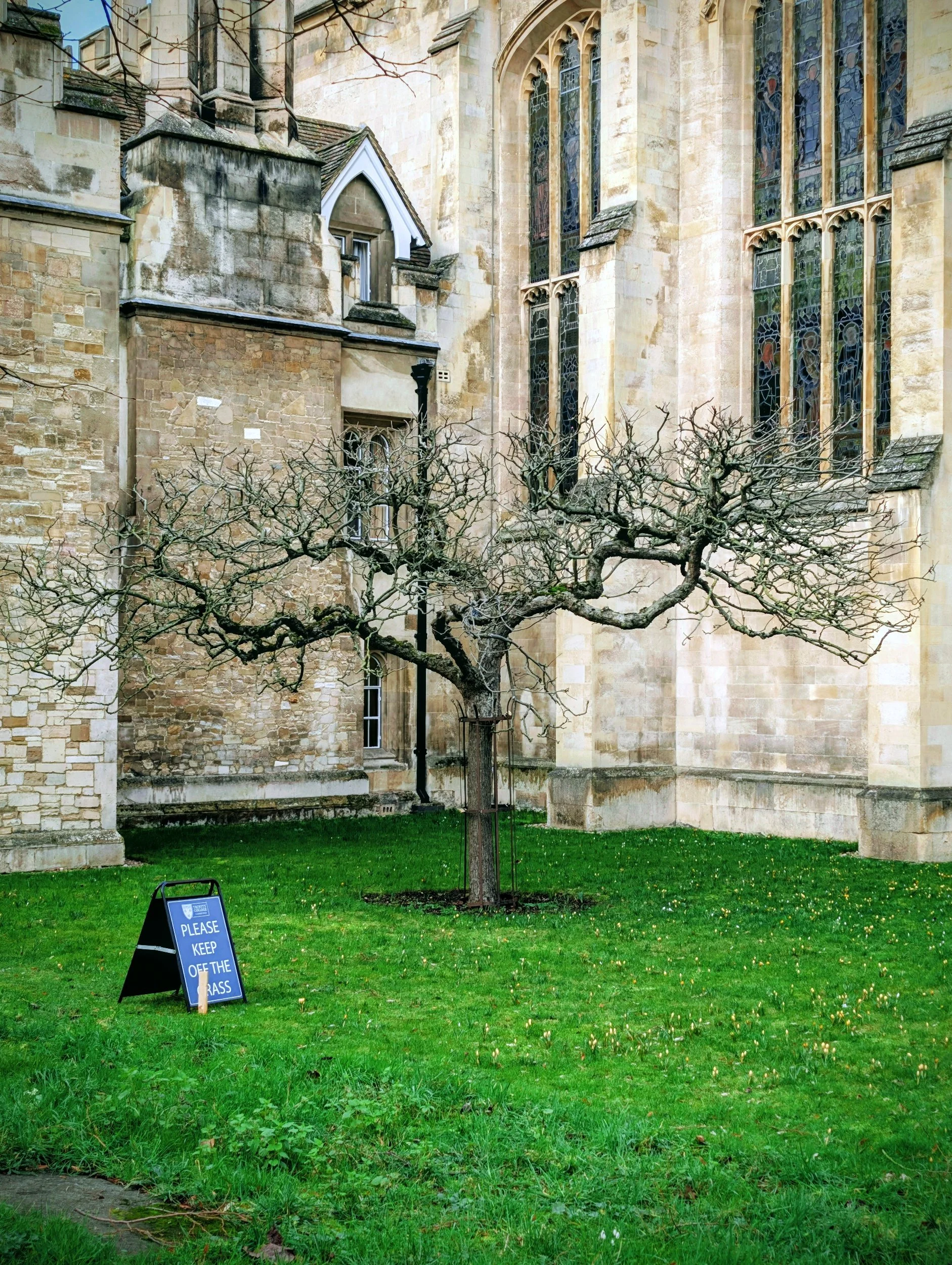
In the manicured courtyard of Trinity College, Cambridge, just outside the rooms once occupied by Sir Isaac Newton, stands a relatively modest, gnarled tree that carries the weight of a scientific revolution. To the casual observer, it is merely a fruit tree; to the Explorers Insight reader, it is a Newton's Apple Tree clone—a living biological monument that bridges the gap between 17th-century physics and modern botanical preservation.
Understanding this tree requires peeling back the layers of myth to find the specific "insight" that connects a falling piece of fruit to the laws of universal gravitation.
The Myth vs. The Mathematical Reality
The popular narrative suggests that an apple struck Isaac Newton on the head, sparking an instantaneous "Eureka" moment. However, the historical record—supported by Newton’s own memoirs and the writings of his contemporary, William Stukeley—paints a more contemplative picture.
In 1665, the Great Plague forced Newton to leave Cambridge and retreat to his family home, Woolsthorpe Manor in Lincolnshire. It was there, while watching an apple fall in the orchard, that he began to ponder why the fruit always descended perpendicularly to the ground. This observation led to the realization that the same force pulling the apple to the Earth was the force keeping the Moon in orbit. This was the birth of the Philosophiæ Naturalis Principia Mathematica.
The Trinity Clone: A Biological Duplicate
The tree currently seen at Trinity College is not the original 17th-century specimen, as the "mother tree" at Woolsthorpe Manor blew down in a storm around 1820. However, the root system survived, and the tree regrew. More importantly, it became the source for every Isaac Newton apple tree found in scientific institutions globally.
The Science of Grafting
The tree at Trinity is a direct Newton's Apple Tree clone, created through the ancient horticultural practice of grafting. A "scion" (a small branch) was taken from the original Woolsthorpe tree and fused onto a hardy rootstock.
The Variety: The tree is a Flower of Kent, a traditional cooking apple variety.
The Appearance: It produces large, green-and-red streaked apples that are mealy when raw but excellent for stewing—a humble variety that arguably changed the course of human history.
The 2026 Perspective: Botanical Resilience
In early 2022, the Newton tree at the Cambridge University Botanic Garden was toppled by Storm Eunice. This event served as a stark reminder of the fragility of living monuments. However, because the University maintains a rigorous program of grafting, a "backup" clone was already prepared and planted nearby. This ensures that even as individual trees fall, the Newton's apple tree lineage remains an unbroken thread of scientific heritage.
🧭 Strategic Insights: Where to Find the Legacy
While the specimen at Trinity College—positioned strategically outside Newton’s historic rooms as a symbolic "intellectual homecoming"—remains the most iconic, a broader "Newtonian Diaspora" has preserved this specific genetic lineage through several key botanical sites. This network includes the original "Mother Tree" at Woolsthorpe Manor, the authentic site of the 1665 gravity observation, as well as institutional clones like the one at The Royal Society in London, which serves as a tribute to Newton’s influential tenure as its President. Furthermore, the Cambridge University Botanic Garden maintains a research clone specifically to study the genetics of ancient varieties, ensuring that this 17th-century biological artifact remains an active subject of modern scientific inquiry rather than just a static monument.
-
While the trees do fruit, the apples at Trinity College are generally not harvested for public consumption. Furthermore, the Flower of Kent is a "sub-acid" cooking apple; it is quite tart and fibrous if eaten straight from the branch.
-
No. The original observation happened in Lincolnshire. The Trinity tree was planted in 1954 as a gift from the Fruit Research Station at East Malling, grown from a graft of the Woolsthorpe original. It represents the "intellectual homecoming" of the discovery to Newton’s college.
-
Authentic clones are usually accompanied by a certificate of provenance. Many were distributed to physics departments globally during the 20th century, including sites in the US, Japan, and Australia.