
The Corpus Clock Cambridge
Decoding the Predator of Time
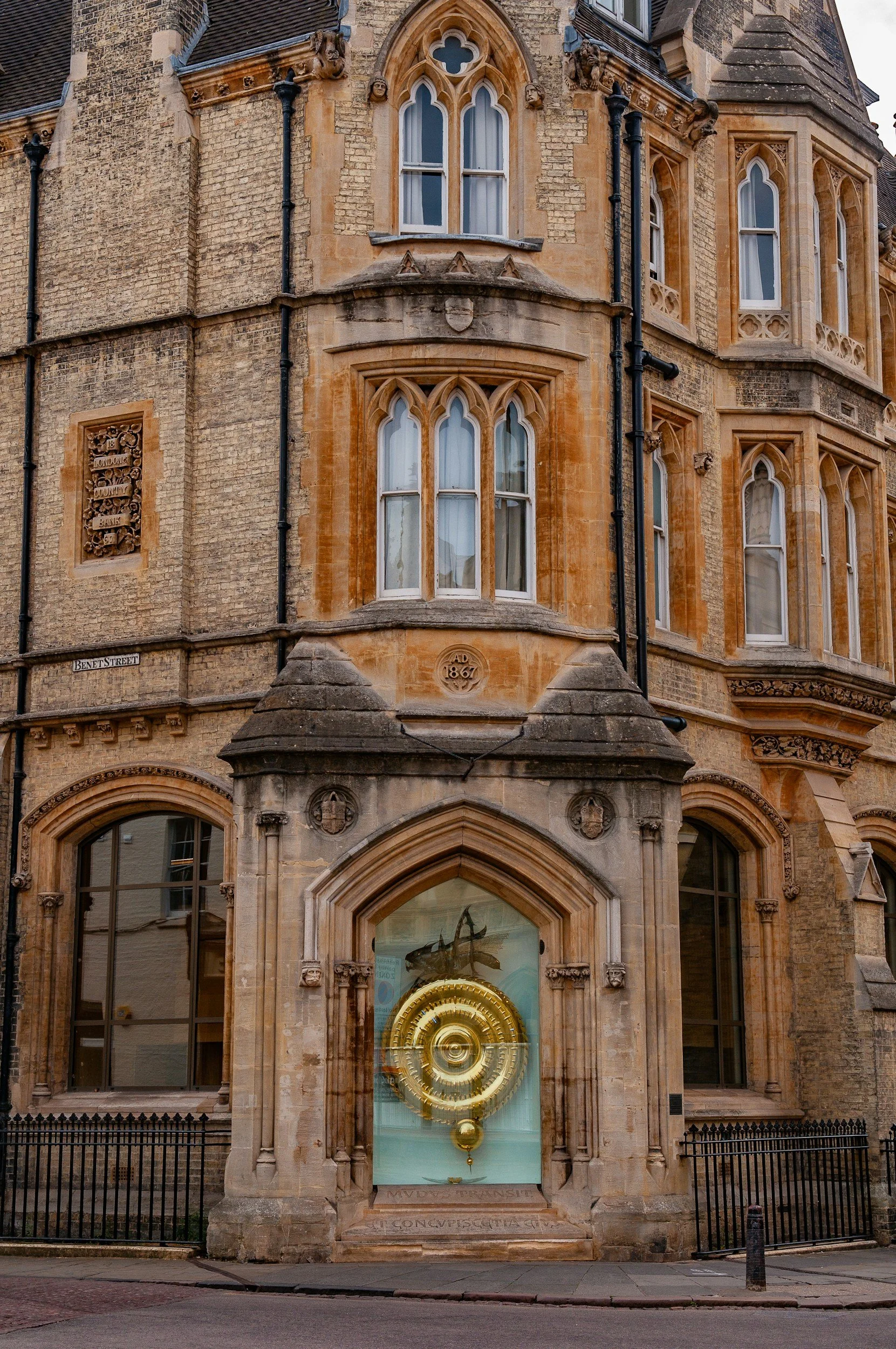
In a city defined by the pursuit of timeless truths, the Corpus Clock stands as a jarring, brilliant reminder of the opposite: the relentless, predatory nature of time itself. Unveiled in 2008 by the legendary physicist Stephen Hawking, this gold-plated monument at the corner of Bene't Street and Trumpington Street is not merely a timepiece; it is a philosophical provocation in the form of a 24-carat mechanical beast.
For the Explorers Insight reader, the clock represents a masterclass in "Horological Art"—a fusion of medieval mechanical principles and 21st-century artistic cynicism.
The Creature of Time: Understanding the Chronophage
The most striking feature of the clock is the Chronophage, or "Time-Eater"—a terrifying, grasshopper-like creature that sits atop the three-meter-wide dial. Designed and funded by John C. Taylor, an alumnus of Corpus Christi College, the clock lacks hands and numbers. Instead, time is marked by blue LEDs that illuminate through slits in the shimmering gold face.
The Predatory Motion: Every minute, the Chronophage’s jaw snaps shut, symbolically "eating" the sixty seconds that have just passed. Its eyes blink at irregular intervals, and its scaly body heaves as if digesting the very fabric of our lives.
The Grasshopper Escapement: Technically, the creature is a highly enlarged "Grasshopper Escapement," a mechanism originally invented by John Harrison in 1722 to solve the problem of longitude. Taylor’s insight was to turn this internal mechanical component into an external, predatory monster.
The Historical Dissonance: A Tribute to John Harrison
While the clock looks like something from a dystopian future, its heart is rooted in 18th-century maritime history. John Harrison, a self-taught carpenter and clockmaker, revolutionized navigation by creating clocks that could keep accurate time at sea.
The Corpus Clock honors Harrison by utilizing his specific escapement design but adds a layer of "Cambridge Irony." Unlike Harrison’s clocks, which were designed for perfect precision, the Corpus Clock is intentionally innacurate. It speeds up, slows down, and even stops for several seconds, only to "catch up" to the correct time every five minutes. This serves as a mechanical metaphor for the human perception of time—how it drags during a lecture but flies during a moment of joy.
🧭 Strategic Insights: The Geographical Legacy of the Chronophage
While the primary specimen remains a fixture of the Cambridge streetscape, the legacy of the "Chronophage" extends through a series of specific historical and academic coordinates. The most significant of these is the Taylor Library at Corpus Christi College, which serves as the clock’s protective housing and a monument to the donor’s contributions to horological science. Beyond the college walls, the original design philosophy can be traced back to the Royal Observatory in Greenwich, where John Harrison’s original H1 through H4 marine chronometers are preserved—providing the essential mechanical DNA that Taylor scaled up into his golden beast. For those seeking a deeper dive into the artistic evolution of the piece, the Science Museum in London holds early sketches and prototypes of the escapement, offering a rare look at the transition from 18th-century engineering to 21st-century conceptual art.
-
There is no bell. Instead, the "chime" is the sound of a chain clanking into a wooden coffin, which remains hidden behind the clock face. This is a deliberate memento mori (remember you must die), reinforcing the clock’s theme that every hour brings us closer to the end.
-
The dial is made from a single sheet of stainless steel that was "exploded" into shape using underwater explosives (a technique known as explosive forming). It was then plated in 24-carat gold. The ripples in the metal represent the Big Bang and the beginning of time itself.
-
The clock is most impressive at dusk or night. The blue LEDs contrast sharply against the gold, making the "ripples" of time appear more three-dimensional. Because it is positioned behind a glass window on a public street, it is accessible 24/7.