
Cambridge Historical Expedition
A Guided Academic Walking Itinerary
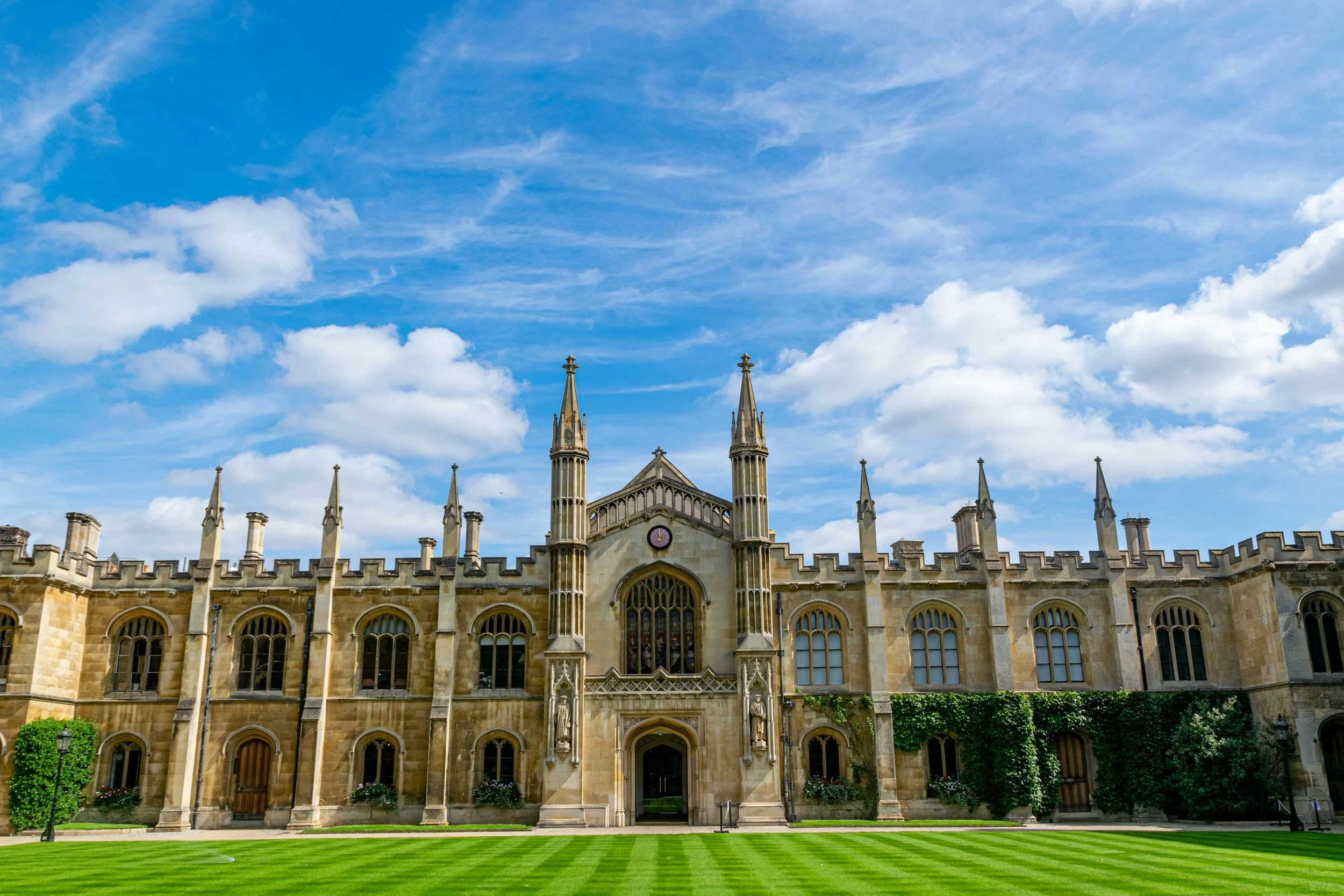
Begin your journey at Cambridge Station. To reach the historic core, exit the station and walk for 20 minutes down Station Road and Hills Road. Alternatively, board the Universal (U) bus, which offers a direct 7-minute transit to the southern end of the university's historic district
1. The Fitzwilliam Museum
This premier university museum is housed in a grand Neoclassical building that serves as a monument to art and antiquity.
Description: Founded in 1816, it is the flagship of the University of Cambridge Museums and holds over half a million artifacts. The architecture features a formidable Corinthian facade and a lavish Victorian Grand Entrance Hall.
Admission Fee: Entry to the museum is free for all visitors.
What to Visit Inside:
The Lower Galleries: Explore the Egyptian collection, including the massive red granite lid of the Sarcophagus of Ramesses III and 9th-century BC Assyrian Reliefs.
The Upper Galleries: View Old Master paintings by Titian, Rembrandt, and Rubens, alongside extensive collections of pottery and porcelain.
2. King’s College and Chapel
This iconic college is the most recognized symbol of Cambridge, representing a pinnacle of perpendicular Gothic architecture.
Description: Founded by King Henry VI in 1441, the college features a "palace of learning" that took over five centuries to complete.
Admission Fee: There is an entry fee for tourists, typically ranging from £12 to £15, though it is free for Cambridge residents and those attending religious services.
What to Visit Inside:
The Chapel: Observe the world's largest fan-vaulted stone ceiling and the complete set of 16th-century Tudor stained-glass windows.
The Altarpiece: View "The Adoration of the Magi" by Peter Paul Rubens, located behind the high altar.
The Grounds: Walk toward "The Backs" to see the neoclassical Gibbs Building and the Xu Zhimo Memorial stone.
3. Mathematical Bridge (Queens' College)
This famous wooden footbridge connects the medieval and modern sections of Queens' College across the River Cam.
Description: Designed by William Etheridge in 1749, the bridge is celebrated for its sophisticated radial geometry using only straight timbers to create an arch.
Admission Fee: While viewing from the public Silver Street Bridge is free, walking across it requires paying for entry to the Queens' College grounds.
What to Visit Inside:
Structural Joinery: Examine the "radial stepping" technique where timbers are arranged as tangents to the arch.
Old Court and Cloister Court: Accessible via the bridge, these represent the medieval "Dark Side" of the college.
4. Trinity College and the Great Court
As the wealthiest Cambridge college, Trinity boasts a legacy of immense scientific and literary achievement.
Description: The college was the academic home of Sir Isaac Newton and features the Great Court, the largest enclosed courtyard in Europe.
Admission Fee: Visitors typically pay an entry fee at the Great Gate to access the college courts and chapel.
What to Visit Inside:
Newton's Apple Tree: See the famous clone of the tree that inspired the law of gravity, located just outside the Great Gate.
The Great Court: Walk the perimeter of the historic courtyard where the traditional "Great Court Run" takes place.
Wren Library: If open, this 17th-century library houses significant historical manuscripts.
5. Great St Mary’s (The University Church)
This historic church serves as the official center point of the University and the city.
Description: A fine example of Late Perpendicular Gothic architecture, it has been a site of worship and academic ceremony for centuries.
Admission Fee: Entry to the church is generally free, but there is a small fee required to climb the tower.
What to Visit Inside:
The Tower: Climb the 123 steps for a 360-degree panoramic view of the Cambridge skyline, including King's College Chapel.
The Nave: Observe the unique "University Pit" seating arrangement used for academic sermons.
6. Museum of Archaeology and Anthropology (MAA)
This museum houses a vast collection spanning two million years of human history and global cultures.
Description: Housed in a 1913 purpose-built structure, the MAA bridges the gap between local archaeological finds and global ethnographic research.
Admission Fee: Entry to the museum is free for all visitors.
What to Visit Inside:
Ground Floor: View local Anglo-Saxon and Roman finds, including rare Star Carr antler frontlets.
The Stairwell: Look up at the massive 14-meter-tall Haida totem pole from British Columbia.
First Floor: Explore the Clarke Gallery for Oceania and contemporary indigenous art.
7. Sedgwick Museum of Earth Sciences
The university’s oldest museum offers a journey through 4.5 billion years of planetary history.
Description: Named after geologist Adam Sedgwick, it houses over one million specimens, including significant fossils and minerals.
Admission Fee: Admission is free for all visitors.
What to Visit Inside:
Woodwardian Cabinets: See the world’s oldest intact fossil collection in its original 18th-century walnut cabinets.
The Iguanodon: View the Victorian-style upright mount of an Iguanodon skeleton near the entrance.
Darwin's Beagle Collection: Examine rocks and fossils collected by Charles Darwin during his famous voyage.
8. University Museum of Zoology
A striking modern space dedicated to the diversity of animal life and biological evolution.
Description: This museum serves as a research library for comparative anatomy, showcasing everything from extinct giants to microscopic life.
Admission Fee: Entry is free for the public.
What to Visit Inside:
The Whale Hall: Walk under the massive 21-meter Fin Whale skeleton suspended in the glass entrance hall.
The Great Gallery: Trace the "Tree of Life" and see Darwin's original specimens from the Galápagos.
The Whale Café: Enjoy a coffee with a unique view of the whale skeleton.